The three inclined-shooting rules put to the test: where they agree and where they part ways.
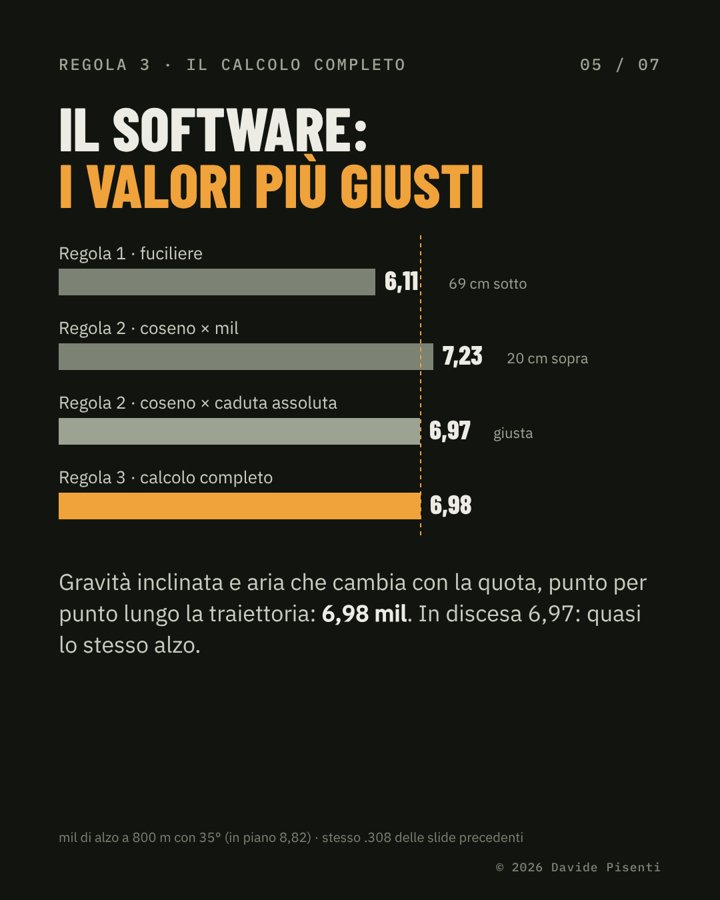
Rifleman's, improved and full calculation: at 800 m and 35° they give 6.11, 7.23 and 6.98 mil.
Up to 500 m and 20° the rules stay within 5 cm; at 800 m the rifleman's rule shoots 69 cm low.
Never count the angle twice: the shot would go low.
Uphill and downhill, the bullet drops less than on flat ground. How much elevation do you dial? The three rules described by Bryan Litz in his book, put to the test with the app's ballistic engine: where they agree and where they part ways.
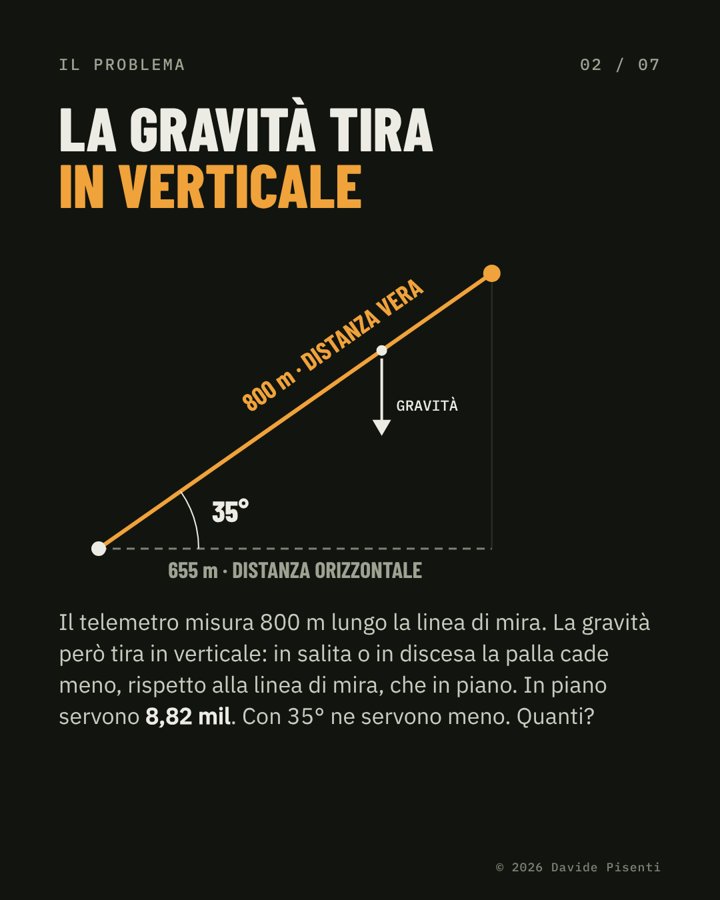
The rangefinder measures the distance along the line of sight. Gravity, however, pulls vertically: uphill or downhill the bullet drops less, relative to the line of sight, than on flat ground. Example: target at 800 meters at a 35° angle. On flat ground you would need 8.82 mil. At 35° you need less. How much?
Take the horizontal distance (800 m at 35° becomes 655 m) and dial the elevation you would use on flat ground at that distance: 6.11 mil. It is the simplest rule and works at small angles, but the more distance and angle grow, the more elevation it takes away.
Multiply the cosine of the angle by the bullet's absolute drop from the bore axis at the true distance. That is the correct drop: 6.97 mil, like the full calculation. Not all software shows absolute drop: in that case Litz says to multiply the cosine by the flat-ground mils at the true distance (8.82 × 0.82 = 7.23 mil). It is an approximate application of the improved rule: with a 100 m zero the approximation is very good, slightly high; with a long-range zero it is better avoided.
The software follows the real trajectory point by point, with inclined gravity and air that changes with altitude: 6.98 mil uphill, 6.97 downhill. Almost the same elevation, and the most accurate values.
Error of the two field rules compared with the full calculation, on the target:
| Shot | Rule 1 · rifleman's | Rule 2 · cosine × mil |
|---|---|---|
| 300 m · 10° | exact | 1 cm high |
| 400 m · 15° | 1 cm low | 2 cm high |
| 500 m · 20° | 4 cm low | 4 cm high |
| 600 m · 30° | 18 cm low | 11 cm high |
| 800 m · 35° | 69 cm low | 20 cm high |
| 1000 m · 30° | 143 cm low | 20 cm high |
.308, 175-grain bullet, 800 m/s, G7 BC 0.243, sight 6.85 cm above the bore, zero at 100 m, 15 °C, 1013 hPa, humidity 0%.
Up to 500 meters and 20° both rules stay within 5 cm. Beyond that, the rifleman's rule goes wrong fast; the improved rule stays within 20 cm. The full calculation is always the right measure.
Many rangefinders already give the distance "corrected" for the angle. If you then also enter the angle in the calculator, the angle is counted twice and the shot goes low. Either the true distance and the angle, or the corrected distance without the angle: never both.
The app does the full calculation on its own, uphill and downhill, always keeps degrees and cosine in step, and warns you when the angle is active.