Same reasoning as the .308, very different numbers: zero, range and wind with the rimfire.
With a 50 m zero the bullet never rises more than 7 mm.
A 10 m error in the zero is worth up to 6 cm at 200 m.
At 100 m it moves the .22 five times more than the .308.
The .308 is zeroed at 100 meters. The .22 LR is not: it is zeroed at 50. The reasoning is the same, but the numbers are very different, and there is one enemy that weighs five times more at 100 meters.
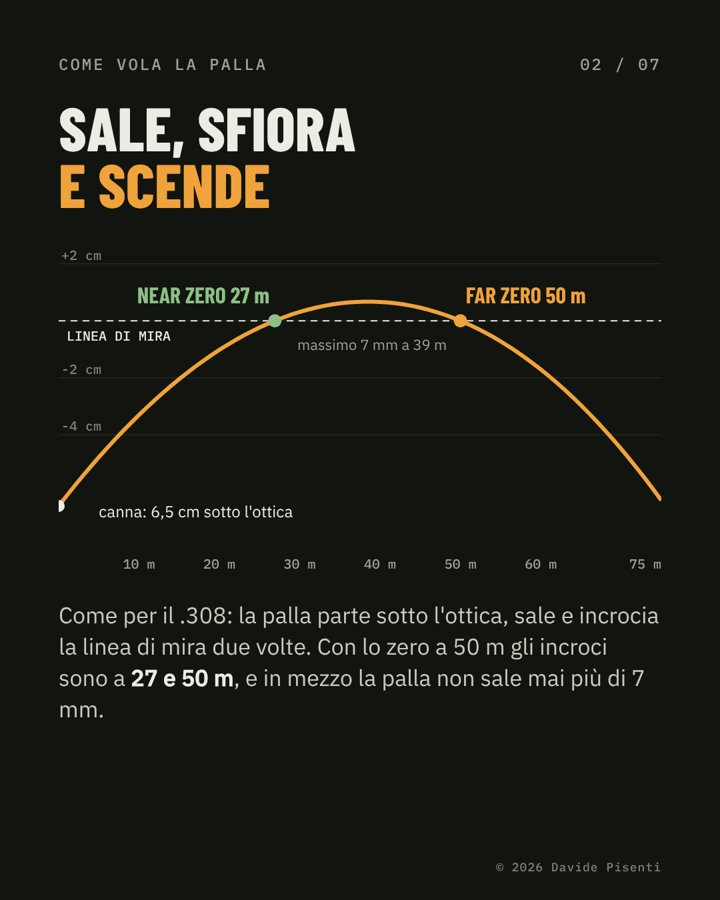
As with the .308, the bullet starts below the scope, rises and crosses the line of sight twice. With a 50-meter zero the two crossings are at 27 and 50 meters, and in between the bullet never rises more than 7 millimeters.
| With a 50 m zero | Value |
|---|---|
| First crossing (near zero) | 27 m |
| Second crossing (far zero) | 50 m |
| Maximum height above the line of sight | 7 mm at 39 m |
| Span within 1 cm of the line of sight | out to 56 m |
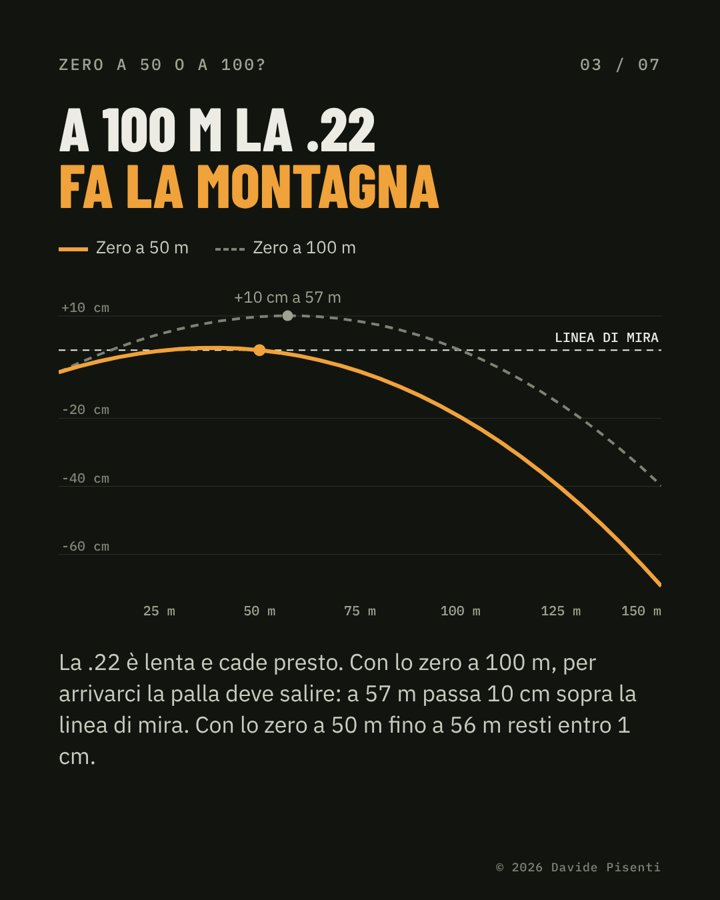
The .22 is slow and drops early. With a 100-meter zero, the bullet has to climb to get there: at 57 meters it passes 10 centimeters above the line of sight. On a match target, that is already a lost shot.
With the .308, a 10-meter error in the zero range moves the shot by less than 1 centimeter at 500 meters. Not with the .22: the trajectory is much more curved. A zero done at 40 or 60 meters instead of 50 moves the shot like this:
| Shooting distance | Shot displacement |
|---|---|
| 100 m | up to 3 cm |
| 150 m | up to 4 cm |
| 200 m | up to 6 cm |
The 50 meters must be measured, not estimated.
A 10 km/h full-value crosswind. With the .308 at 100 meters it moves the shot 1.4 cm; with the .22, 7.4 cm, more than five times as much.
| Range | 10 km/h crosswind |
|---|---|
| 50 m | 2.0 cm |
| 100 m | 7.4 cm |
| 150 m | 15.9 cm |
| 200 m | 27.3 cm |
.22 LR, 334 m/s, BC G1 0.154, sight 6.5 cm above the bore, standard atmosphere.
Measure the 50 meters with a rangefinder or a measuring wheel: with the .22, a 10-meter error shows.
Pick a day with no wind: even at 50 meters, 10 km/h moves the shot 2 cm.
At least 5 shots: correct on the center of the group, not on a single shot.
Zero with the ammunition and lot you will use in the match.
The app shows near zero, far zero, trajectory and wind at a glance, for the .308 as for the .22.